Paul Cameron


What causes homosexual desire? A BIG question since LBGTs are growing (23% of U.S. adults <30 yrs per Gallup in 2025 ) while heterosexuality (and the U.S. birth rate) are shrinking. President Eisenhower, following Christianity’s stance, said homosexuality was wicked. Finland’s Supreme Court ruled (3 to 2) against an Evangelical Lutheran cleric and his Parliamentarian wife for saying "homosexuality was due to disordered psychosexual development," thus, the Court contended, "falsely" suggesting homosexuality was inferior to heterosexuality (when the Court holds them equal), and thereby “insulted homosexuals as a group” [Helsinki Times 3/26/26]! While Christianity has no official theory of etiology, many of its Fathers warned "thou shalt not corrupt boys," suggesting this vice was behaviorally transmitted (as in Afghanistan and Pakistan today). The 1987 Gay Community News well knew this when it threatened: “We shall sodomize your sons, … All churches who condemn us will be closed. Our only gods are handsome young men” [February 15-21]. AI estimates that about 9% of U.S. secularists, 20% of Jews, 70% of Christians (85% of Evangelicals), 30% of Democrats, and 60% of Republicans agree with Eisenhower. Supporting the gay movement, the major polls haven’t asked how many U.S. adults believe homosexuality is "equal to/just as good" as heterosexuality, but it is growing.
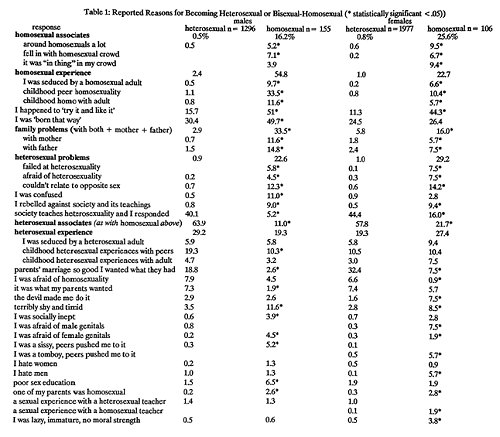
In 1983-4, I led a team asking a random sample of ~5,000 adults: “Why do you think you became this way? Where previous researchers had only asked homosexuals, we asked heterosexuals as well. The questionnaire was extensive: we asked about respondent's sexual desire (not really sexual, not interested/ only sexually interested in and attracted to the opposite sex (I'm "exclusively heterosexual")/ generally attracted to members of the opposite sex, but sometimes am sexually attracted to members of my own sex/equally sexually attracted to members of both sexes (I'm "bisexual"/ generally attracted to members of my sex, but sometimes I'm sexually attracted to members of the opposite sex/only sexually interested in and attracted to members of my own sex (I'm "exclusively homosexual"); the first sexual experience (respondent's age, age and sex of partner, who took the initiative and whether the event was homosexual or heterosexual); and current sexual orientation (I am a: heterosexual/ bisexual/ homosexual). We asked respondents ("at what age were you first 'in love' with") or were they currently "in love" with; whether he had ever been sexually aroused by ("how old were you when you first felt sexually aroused by"); was sexually attracted to; and had ever been a sex partner of male(s) and/or female(s) prior to and during adulthood. After being asked if they were heterosexual, bisexual or homosexual, respondents were asked “why do you think you became this way?” Respondents were given 43 possible reasons (e.g., "seduced by a heterosexual adult," "fell in with a homosexual crowd," gotten from the literature which are summarized in Table 1), for having adopted their current sexual preferences/orientation.
As with others, we found no completely satisfying way to divide the sample into homosexuals & heterosexuals. If we considered only those who characterized themselves as “bisexual” or “homosexual,” we excluded a significant fraction who, as adults, reported having engaged in homosexuality. Additionally, it appeared some respondents had, over time, changed their preferences. So respondents were divided into those who reported that their sexual desires at interview were “exclusively heterosexual” (no matter what they might have done sexually in their past) or “generally heterosexual” but never engaged in homosexual acts in adulthood v. those who said that they were “generally heterosexual” but had participated in homosexual acts after age 17 or currently said they were bisexual or homosexual (ns vary somewhat from question to question, the 3% who chose "not really sexual, not interested" were excluded). Thus, 15% of the males & 33% of the females counted as "homosexual" reported having engaged in homosexual sexual relations after age 17 and rated their "sexual desires" as “generally heterosexual.” Overall, 9% of our sample of men and 5% of our women were "homosexual."
Reasons given for their sexual preferences are summarized by orientation and sex in Table 1 (we combined "dominating/suffocating" and/or "distant or absent" mother and/or father under "problems with" mother or father). Responses could choose as many as they wanted, those differences that would be statistically significant had they been independent got an asterisk. If the percentages for each subsample referring to sexual activity (e.g., heterosexual and homosexual experiences, “tried it, liked it”) are combined as an index of experience as cause, homosexuals more frequently reported that they were "created" by sexual experience than heterosexuals did. Thus, heterosexual men claimed 47.3%, homosexual men 125.1%, heterosexual women 31.6%, and lesbians 94.4% experiential pressure. Associational pressure (e.g., homosexual or heterosexual associates) was nominated by 64.4% of heterosexual men, 27.2% of homosexual men, 58.6% of heterosexual women, and 47.3% of lesbians as "creating/influencing" their sexual orientation. This associational pressure appears congruent with their respective reports of “responding to what society teaches” [when used by our homosexuals, this response was employed almost exclusively by those whose desires were “generally heterosexual” or “bisexual”] and “rebelled against society” [used primarily by homosexuals who characterized themselves as “homosexual”]. Good parental model and relations (“parents’ marriage so good,” “what my parents wanted”) were cited by about a third of heterosexuals, while conflicts with parents were cited by about a quarter of homosexuals. Notice that respondents said parental influence was trumped by experiential pressure (which Church fathers also mentioned). You never know how a given child will react to sex with an adult: of men who reported they had boyhood sex with their father, one said he was heterosexual, one bisexual, and the other homosexual. The woman who reported sex with her grandmother said she was exclusively heterosexual (and said she "hated women").
Table 1 offers a rough way to estimate the amount of pathology associated with the two primary orientations. Sex with an adult responses, totaled 16.2% for the heterosexual men, 34.2% for the gays, 11.7% for the heterosexual women, and 38.6% for the lesbians. The % saying they were troubled (e.g., confused/inept) went 1.1 for hetero men, 14.9 for gays, 1.6 for hetero women, and 5.6 for lesbians. The % reporting rebellion (including "the devil made me do it"), ran 3.7, 11.6, 2.1, and 16.9. The % implicating personal flaws (e.g., "lazy, shy & timid") ran 4.0, 12.2, 3.3, and 12.3. For each comparison, the frequency of pathology reported by the homosexuals fits better with the Finnish Evangelical Lutherans, instead of the Finnish Supreme Court’s stance regarding the equality of orientations. As to etiology, the Church Fathers’ emphasis upon being corrupted by sex with men gained some serious validation, while how the “disordered psychosexual development” theory fares is less certain.
The Biden administration shared the views of the Finnish Court about homosexuality, but its 2022 HHS Regulations noted (p. 32) that LGBTs reported “being in poorer health, [while being] at increased risk for or are particularly affected by [STDs], obesity, conditions associated with tobacco, alcohol, and other substance use, and mental health conditions, including suicidality, [and] are more likely to acquire a disability at a younger age.”
How can those who experienced more pathology as they were developing their sexual tastes end up "equal" to those who experienced less? More insights from this study shortly.
The views expressed by RenewAmerica columnists are their own and do not necessarily reflect the position of RenewAmerica or its affiliates.