
Paul Cameron


When people lived in small groups, it was evident that babies grew into adults who aged and died. Women knew that unless the men could steal women and/or children from other bands, they had to give birth for their clan to continue. The world’s population usually grew – with a Total Fertility Rate [TFR] exceeding 2.1 – when the division of labor had men primarily ruling/fighting/producing/gathering, while women primarily did household and child-raising. Both Christianity and Islam told men to steer women (e.g., Genesis 3:16: “your desire shall be for your husband, and he shall rule over you;” Surah An-Nisa 4:34: "Men are the protectors and maintainers of women [if they rebel] forsake them in bed and strike them”) suggesting that women’s beliefs or attitudes were disproportionately harmful. The U.S. founders echoed these sentiments in recommending that only men (with property) should be allowed to vote.
Although the U.S. has a falling TFR, and nothing accomplished will mean anything unless we sustain our demographic, our medicine disproportionately targets babies!
- We discourage pregnancies with 1) contraceptives; 2) morning-after pills; and 3) abortion pills that block or end pregnancies, obtainable without anyone knowing, and with minor risk. Further, 4) surgical abortion is easily obtained in half the states.
- Pregnancy is encouraged by 1) pregnancy and birth are less risky than any other time in history; 2) federal financial subsidies for babies; and 3) IVF [in vitro fertilization] to aid in getting pregnant (it comes with considerable inconvenience and cost, with a modest degree of success (which usually involves destroying unwanted fetuses).
Babies take time: Before birth, 70-80% of mothers-to-be can expect fatigue, nausea, etc., for about 2-6 hours a day or ~600-1,400 hours of reduced functionality. The other 20-30% of these mothers will have additional hours of reduced functionality. About 95% of newborns are born healthy and 43,800 additional hours pass as a newborn grows to be 5 years old. AI says an average child requires about 3,600 hours of attention during this period of growth (e.g., 1,000 hours of feeding and diaper changing, 1,500 hours of sleeping, 500 hours of playtime, 200 hours of healthcare, 400 hours of learning/education). Children outside the average will require more hours of attention, and the mother will have less time to do other things.
If both parents work full-time, each will spend 11,250 hours commuting/working (about a quarter of their life-hours); 11 hours sleeping/dressing/personal hygiene/day ~ 46% of their life-hours. That leaves ~12,500 life-hours for shopping, cleaning, repairing, personal medical care, car maintenance, etc., to be split between them. Even if parents split care of the baby equally, if there are no older children or relatives to assist, they will have to spend about 15% of their "free time" with the baby. Being a mother is a sacrifice of pain and time, and without them, nothing endures beyond a few decades. Additional aspects of motherhood to be considered are summarized in Table 1. Row one shows that in the 1700s, U.S. women knew pregnancy and birth carried more risk than "just living" (AI says 7-9 X riskier: there were no antibiotics, poorer sanitation, horse-drawn transportation, etc.). Everyone knew that many of their children would not live beyond age five (AI says 200-300 of every thousand babies died before age 5). In spite of these discouraging statistics, only 5% of women never had a child. By the 1900s the number of children who died by age 5 per thousand had dropped to about 100 to 150, the number
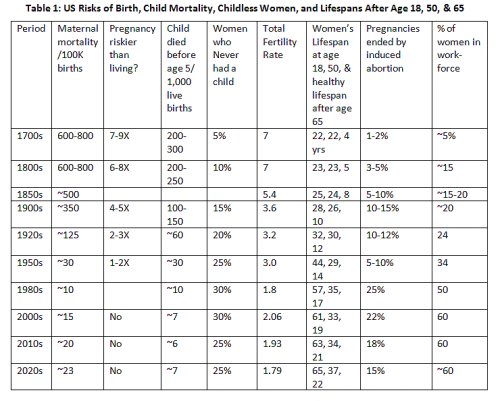
of women dying in childbirth had dropped to about four to five times higher than the general mortality for women their age, and about 15% of women never had a child. By the 2000s, childbirth was no more dangerous than other risks of living, a quarter of women never bore a child, and only about 7 of every 1,000 kids died before age 5. The decline of the U.S. TFR is shown in Column 6. Column 7 shows the average number of years of life remaining for women at ages 18 and 50, and the number of healthy years of life remaining after age 65 (men’s average was always two to four years less at each age). Notice that in the 1700s, if a woman lived to age 18, she was about as apt to live 22 more years as a 50-year-old! By the 1950s, increasing lifespan was evident. AI likely estimated induced abortions from questionnaire studies in column 8, and – given the abortion pills’ growing availability and privacy of use – the decline reported is suspiciously low. In column 9, the steady growth of women entering the workforce can be seen to correlate with a longer lifespan, safer childbearing, and a declining birthrate. Table 1 makes clear that a healthy demographic does not require every woman to get pregnant, but many must have multiple children. As women acquired more wealth, responsibilities, and lifespan, their willingness to replenish community numbers declined.
In 1920, women were given the vote. By 2012, they constituted a majority of the electorate and were being trained to do almost everything men do (in 2006, most college students were female). Professional women often complain “we need low-cost, highly professional nursery school-age care, so we can drop off the child, go to work, and pick them up for dinner and bed.” Yet Sweden, Denmark, and Norway offer this service, and their TFRs have not increased to 2.1. CIA estimates put Denmark’s TFR at 1.5, Norway at 1.58, Sweden at 1.66, the UK at 1.64, and the U.S. at 1.63. About twice as many of these countries’ young adults are cohabiting rather than married (e.g., 50% of Swedes, 46% of Danes, 44% of US v 20%, 25%, and 30% of U.S. young adults are married). Cohabitation, held together by personal commitment is associated with a lower birthrate (0.3-0.4 less TFR) than married couples achieve. This entry of "trial marriage" during the most fertile years for mating could account for much of our TFR decline.
Women are often perplexing: they give life, but often support policies or choose lifestyles associated with lowering the TFR. Thus, women are more apt than men to "own a pet rather than have a child;" reject partners who do not agree politically; and engage in homosexuality. Women more frequently say they support easier access to abortion, childlessness, and cohabitation rather than marriage; and they initiate about two-thirds of divorces; but paradoxically also more frequently attend religious services, say they find babies fetching, and volunteer to serve kids.
Women constitute 51% of voters, and trend Democrat. In the last election, 55% of women voted Democrat, 41% Republican while 59% of men voted Republican. 56% of Democrat office holders are women v 26% of their Republican counterparts. The Democrat party is the women’s party – yet it more frequently supports abortion, homosexuality, and childlessness. Perhaps not surprisingly, Democrat voters have a TFR significantly lower than that of those who vote Republican. Women are more frequently becoming homosexual (as of 2026, CA, DC, CO, DE, IL, ME, NJ, & NY mandate In Vitro Fertilization for lesbians. These eight Democrat states/areas combine for a TFR ~1.67-170; states without such a mandate have a TFR of ~1.75-1.80). Women are taking over positions that used to be almost exclusively male (e.g., women were 3-5% of news readers/commentators in 1950, 24% in 1980, 38% in 2000, and 48% in 2025). In the U.S., the Democrat party is associated with policies tending toward a lower Total Fertility Rate; while the Republican Party is supportive of policies associated with higher TFRs (but only higher – no Republican led state has a 2.1 TFR. So Republican states are dying as well, just more slowly). Thus, no U.S. state holds the key to a sustainable TFR of 2.1 children per woman.
Traditionally, toys for boys included soldiers, guns, and building machines or components (as tractors, trucks, erector sets), since they might be required to kill for their society when adult and otherwise will have to build or produce. Those for girls predominated on mother-stuff like dolls and miniature homemaking sets (e.g., dishes, pots and pans, baby clothes and bottles) so girls would anticipate becoming mothers.
AI claims that contemporary studies suggest that around 75% of parents say they believe it is beneficial for girls to play with "boy toys," (and 64% support boys playing with "girl toys"). These stats suggest that most have caught the "girls can do everything that boys do" aspiration of the liberal mindset. Toys influence their users beyond what is seen on screens, because they are parentally and culturally sanctioned.
If many cultures, including our own, prepared children for what they must/should do with toys specific to their sex, we should pay attention. Those who lived before us knew enough to create a replenishing demographic and generally did not have to worry about lessening females’ interest in having babies. We shouldn’t ignore their knowledge because some intellectual decries those toys as "old fashioned" and should be improved upon now that we are all equal. After all, they got 2.1 or better out of their children, and we are not. They passed the baton to us; we are failing to pass it on to our successors.
On a personal note, I shared the concern of grandparents I knew through Sunday School when a couple of decades ago, their daughter decided that her daughter would not be "stereotyped." So, their daughter persuaded her husband that egalitarianism was the way to go, and the granddaughter was given "neutral" clothing (e.g., jeans, never dresses, etc.) and toys of boys more often than those of girls. Obviously, the intent of the mother (at least) was to keep the daughter away from being too feminine in thought and deed. Although the clothing and toys were only part of the campaign in which the mother and father engaged, it had the effect you might expect. It is only one example, but I was able to observe what eventually occurred (rare, since so much time is involved). I expected she might end up trans. I was partially wrong. She stood out from her peers in dress, toys and interests, and … became a lesbian!
God (or nature) appears to have designed our bodies for a division of labor. Only women can have children. If they follow that biological reality, men have more time to create or produce the things that make both sexes’ lives longer and more pleasant. That does not mean that some women might not also create or produce. But, even in our modern world with its many mechanical/electronic/medical blessings, it still seems that the design of our bodies is accommodated – and the reality of our declining TFR might be solved – by expecting men to labor full-time while women devote most of their early adulthood to child rearing.
If every woman did not have easy access to contraception or abortion, and cohabitation were not preferred to marriage, reality might be different. But that the TFR is declining across the first world suggests we are not in a reality that allows women to take male roles full-time in their early years, have children – if and when they fancy – and society still survive.
Somehow, we must raise such an alarm or change society so that most women will receive so many rewards from becoming mothers that they will stop working or reduce their hours worked to enable them to raise children. Their increased absence from employment will, of course, reduce the amount of stuff and innovations that our society produces. But the increasing use of robotics and AI might soon replace much of what women currently contribute and we might "catch up" to where we would have been in a decade or two. TFR is not a "scientific" fantasy as "global warming" or "ethanol will save the planet," but a hard reality upon which our society will crumble if we do not increase it to 2.1.
© Paul CameronThe views expressed by RenewAmerica columnists are their own and do not necessarily reflect the position of RenewAmerica or its affiliates.