


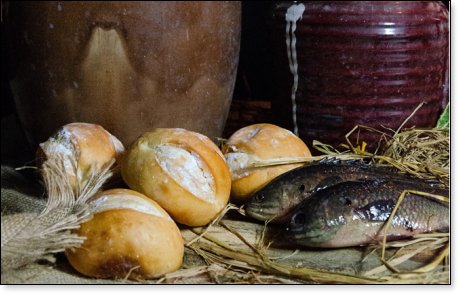
Just for comparison, I present herewith two Popes' sermons on the Miracle of the multiplication of the five barley loaves and two small fish (John 6). Pope Leo doesn’t believe the Miracle was performed by Jesus.
A crowd of 5,000 believers had followed the Twelve apostles, who were returning from their first-ever missionary journey to meet up with Jesus on the mountain. As the people followed Jesus and the Twelve across the Sea of Galilee and up into the hills, they sat down on the grass, exhausted and hungry. Jesus saw they had nothing to eat and had compassion on them.
The location was near Bethsaida; the five loaves of barley bread and two fish were provided by a young boy. The crowd size was approximately 5,000 men, women, and children. The Twelve suggested sending the crowd away to find their own food. Jesus’ Miracle demonstrates His compassion for the hunger of His followers.
Jesus instructed the disciples to bring the five loaves and two fish to him, where he gave thanks to his Heavenly Father, blessed the food, broke the bread and fish, and distributed the food to the 5,000 through His disciples. Everyone ate and was satisfied, with twelve baskets of leftovers collected afterward. There was an abundance of food to satisfy everyone’s hunger, with nothing lost or wasted, but gathered.
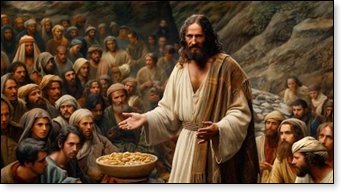
This Miracle of the multiplication of the loaves and fishes is so important that it is the only miracle, aside from the Resurrection, that appears in all four canonical Gospels (Matthew 14:13–21, Mark 6:30–44, Luke 9:10–17, John 6:1–14) with two primary episodes: the feeding of 5,000 (men, excluding women and children in the Gospel counts) and a separate feeding of 4,000 in some Synoptic passages (Matthew 15:32–39; Mark 8:1–10).
However, the Church Fathers have always taught the Miraculous feeding of the crowd as an image of the Eucharist: The Body and Blood of Jesus made really and truly present by the Miracle of God through the anointed hands of the duly ordained Catholic Priest, with the five loaves representing the law and the two fish representing the holy Ministry of the Priesthood.
The Gospel of John 6 speaks of Faith and Reason concerning the Holy Eucharist, and the powers given by Jesus to the ordained Holy Priest, bringing forth the Miracle of Transubstantiation, which is the Eucharistic Body and Blood of Christ.
Transubstantiation is the infallible Catholic doctrine that teaches during the Eucharist Prayer of the Holy Sacrifice of the Mass, through the words of Christ and the action of the Holy Spirit, the bread and wine become the actual body and blood of Christ, while unchanged. The outward appearance of the bread and wine remains unchanged, but their inner essence is transformed. This belief is rooted in Jesus’ words at the Last Supper and was formally defined by the Church at the Council of Trent. Transubstantiation remains a profound mystery in the Catholic faith, emphasizing the belief in the Real Presence of Christ in the Eucharist.
On each Holy Thursday during his pontificate (1979-2005), Pope St. John Paul II wrote a letter to priests around the world. He identified with them as brother priest, while providing catechesis and encouragement as their spiritual father. His first letter in 1979 emphasized the essence and importance of their priestly ministry:
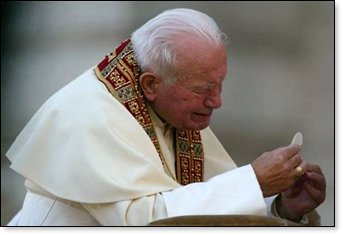
“Think of the places where people anxiously await a Priest, and where, for many years, feeling the lack of such a Priest, they do not cease to hope for his presence. And sometimes it happens that they meet in an abandoned shrine, and place on the altar a stole which they still keep, and recite all the prayers of the Eucharistic liturgy; and then, at the moment that corresponds to the transubstantiation a deep silence comes down upon them, a silence sometimes broken by a sob… so ardently do they desire to hear the words that only the lips of a Priest can efficaciously utter, so much do they desire Eucharistic Communion, in which they can share only through the Ministry of a Priest."
“There can be no Eucharist without the Priesthood, just as there can be no Priesthood without the Eucharist,” Pope St. John Paul II, ‘Gift & Mystery: On the Fiftieth Anniversary of My Priestly Ordination,' New York, 1996, pp. 77-78
Therefore, without the Priest, the world could not continue to exist.
See below two homilies regarding the Miracle of the multiplication of the five barley loaves and two small fish. One Papal homily is magnificent, the other Papal homily is causing confusion and anger.
 1. First homily is given by Pope Benedict’s Faith and Reason sermon on the “Eucharistic” Miracle of the "Loaves and Fishes," spoken on 7/29/2012 on the Gospel of John 6.
https://www.vatican.va/content/benedict-xvi/en/angelus/2012/documents/hf_ben-xvi_ang_20120729.html
2. This second homily here was given by Pope Leo recently, emphasizing social justice themes he often promotes in favor of illegal immigration. Spoken on 4/17/2026 regarding John’s gospel of the feeding of the Loaves and Fish, Pope Leo states the miracle was not that of Jesus’ multiplication but of the hungry people sharing their food with others.
At a later time, when the Twelve Apostles were losing hope again, Jesus said to them:
“And they discussed it with one another, saying:
‘We have no bread.’
And being aware of it, Jesus said to them:
‘Why do you discuss the fact that you have no bread? Do you not yet perceive or understand? Are your hearts hardened? Having eyes do you not see, and having ears do you not hear? And do you not remember? When I broke the five loaves for the 5,000, how many baskets full of broken pieces did you take up?’
They said to Jesus:
'Twelve.’
And Jesus asked:
‘And the seven loaves for the four thousand, how many baskets full of broken pieces did you take up?’
They said to him:
'Seven.’
And He said to them:
‘Do you not yet understand?’" (Mark 8:16-21)[1]
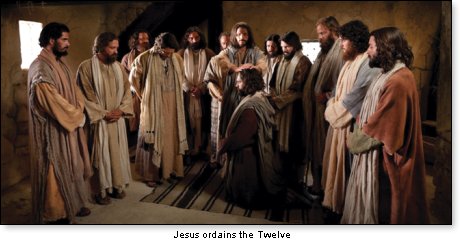
This later interaction of the Twelve with Jesus is significant regarding their lack of faith concerning not having enough to eat. Jesus highlights the theme of Faith and Reason, asking them why they still lack understanding and wisdom after the two miracles regarding food that they had earlier witnessed. Jesus rebukes the disciples’ failure to fully grasp His identity as God and His mission on Earth as Son of God amidst growing opposition and distractions from religious leaders like the Pharisees and from Herod. The Twelve fail to recognize Jesus’ almighty power as the Messiah, which they would later confess as they needed to be prepared for the many challenges ahead.
Endnote:
[1] Jesus’ miracles were, at that 1me, within first-century Judaism, considered different from the expectations of signs and wonders prevalent from other miracle workers within his culture, who performed through prayer rather than by and through their own authority as Jesus, the Son of God, did. Jesus performed the miracle of the loaves and fish; the miracle was not performed by the people who were fed by Jesus.
____________________________
For an appreciation of Pope John Paul II’s role in bringing down oppressive communism, see:
- The Pope Who Helped Bring Down Communism
- How instrumental was Pope John Paul II in the dissolution of Communism; in Poland, Europe, and ultimately the Soviet Union?
The views expressed by RenewAmerica columnists are their own and do not necessarily reflect the position of RenewAmerica or its affiliates.